


Tequila vs Agave vs Mezcal: A Friendly Guide to the World’s Most Vibrant Spirit
Walk into any well-stocked bar or bottle shop, and you’re faced with a wall of beautiful bottles. Some say Tequila, others Mezcal, and a growing number are simply labelled ‘Agave Spirit’. If you’ve ever felt a little lost, wondering what the real difference is and if you’re choosing the right one, you’re not alone. It’s a world rich with tradition, flavour, and a few rules that can seem confusing from the outside.
But here’s the secret: it’s simpler than you think. Think of it as a family of spirits, each with its own unique personality. Agave is the soul, Mezcal is the keeper of tradition, and Tequila is the famous, refined specialist. And now, a new generation of craft makers—including us here in Wales—are adding their own chapter to the story.
This guide is here to clear up the confusion. We'll explore the fascinating differences between these vibrant spirits so you can walk away knowing exactly how to find your next favourite bottle with complete confidence.
Table of Contents
Understanding the Agave Family Tree: What’s in a Name?
Before we dive into the smoky depths of Mezcal or the crisp notes of Tequila, let’s start with the one name that unites them all: Agave. The simplest way to understand what an agave spirit is, is to think of it as the parent category. If a spirit is distilled from the fermented sugars of the agave plant, it’s an agave spirit. It's the broad, all-encompassing term for this entire family of drinks.
So why the different names? It mostly comes down to geography, tradition, and some very strict rules. Much like Champagne can only be called Champagne if it’s made in that specific region of France, Tequila and Mezcal have their own protected homes in Mexico. This is known as a Denomination of Origin (DO), a legal guarantee of quality and authenticity tied to a specific place.
This means that whilst all Tequila is technically a type of Mezcal (which is itself a type of agave spirit), not all Mezcal can be called Tequila. It’s a classic ‘all squares are rectangles, but not all rectangles are squares’ situation. The journey for all of them, however, begins with the heart of the agave plant—the piña—which is slowly transformed into the complex spirit that ends up in your glass.
The Agave Plant: Nature’s Sugar Store
The agave plant is a wonder of the natural world. Often mistaken for a cactus, it’s actually a type of succulent, and there are over 200 different species. Only a handful of these are used to make spirits, but each one brings its own unique character to the final product.
These remarkable plants aren't a quick crop; they take years, sometimes decades, to mature. Throughout their long life, they soak up the essence of their surroundings—the soil, the climate, the altitude. This concept, known as terroir, is why an agave grown in the volcanic soil of Jalisco’s highlands will taste different from one grown in the valleys of Oaxaca. When the plant is finally ready, a skilled harvester, or jimador, undertakes the immense physical labour of cutting away the sharp leaves to reveal the dense, sugar-rich core known as the piña. It’s a true labour of love, a craft passed down through generations.
Tequila vs Mezcal vs Agave Spirit: The Quick Comparison
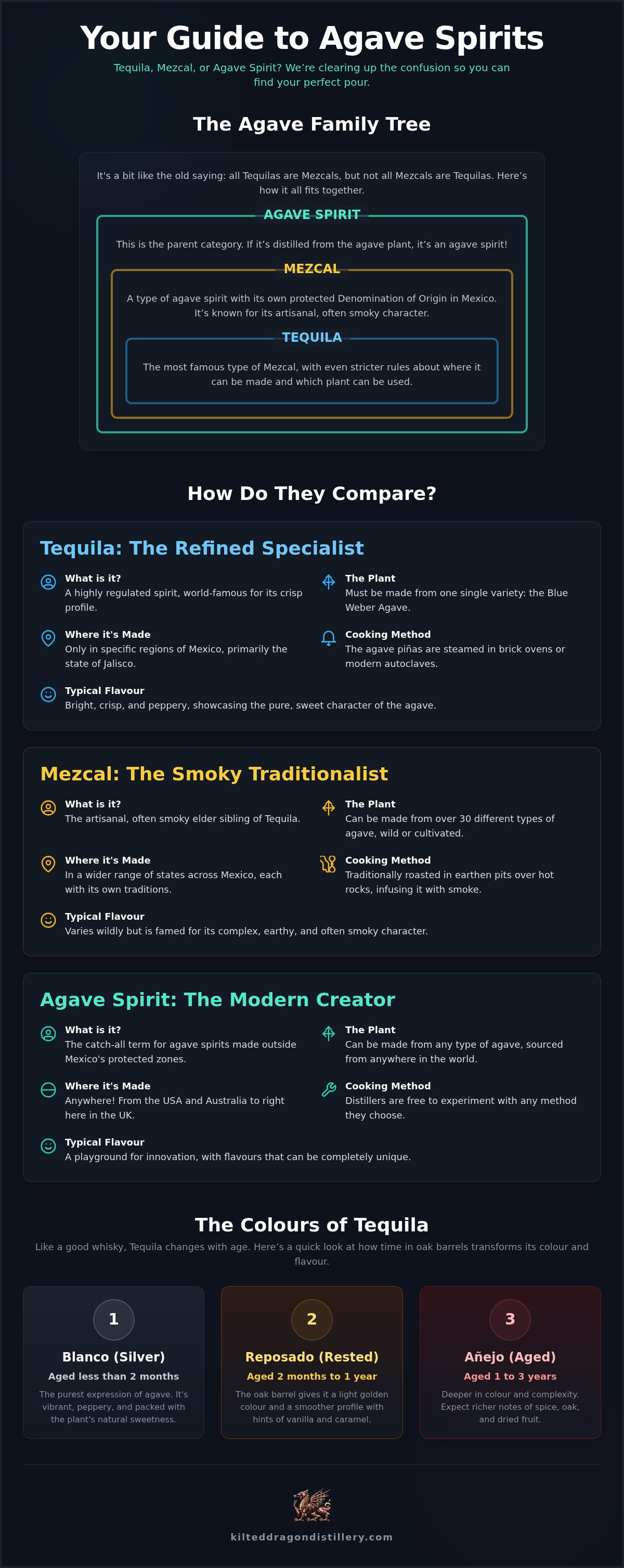
To put it simply, here’s how the family breaks down:
Tequila: The highly regulated specialist. It must be made in specific regions of Mexico (primarily the state of Jalisco) and almost exclusively from a single variety of agave: the Blue Weber Agave.
Mezcal: The artisanal, often smoky elder sibling. It can be made in a wider range of Mexican states from over 30 different types of agave, using traditional, hands-on production methods.
Agave Spirit: The modern, creative category. This is the official term for premium spirits made from agave but crafted outside the legally protected regions of Mexico, including the exciting new wave of bottles produced right here in the UK.
Tequila: The Refined Legend of Jalisco
Tequila is, without a doubt, the world’s most famous agave export. Its global recognition is built on a foundation of strict rules that govern everything from where it can be made to the specific plant used. This legal framework, the Denomination of Origin, ensures that every bottle labelled ‘Tequila’ meets a precise standard of quality and heritage.
At the heart of this spirit is the Agave tequilana, or Blue Weber agave. This is the only species permitted for Tequila production, chosen for its high sugar content and classic flavour profile. When you’re browsing the shelves, you’ll see two key categories. ‘Mixto’ tequilas only need to be 51% agave sugars, with the rest coming from other sources like cane sugar. For a truly authentic taste, however, you should always look for bottles labelled ‘100% Agave’. Your head will certainly thank you for it the next day!
Like whisky or rum, Tequila also evolves with time. It’s often aged in oak barrels, which changes its colour and flavour dramatically:
Blanco (or Silver): Unaged or aged for less than two months. It’s clear, vibrant, and showcases the purest expression of the agave.
Reposado (‘Rested’): Aged in oak for between two months and a year, giving it a light golden hue and a smoother profile with hints of vanilla.
Añejo (‘Aged’): Aged for one to three years in oak barrels, resulting in a darker colour and a richer, more complex character with notes of caramel and spice.
The Steaming Process: Crisp and Clean
What gives Tequila its characteristically bright and often citrusy profile? The answer lies in the cooking process. After harvesting, the piñas are typically cooked using steam. This is most often done in large, industrial-scale stainless-steel ovens called autoclaves, or more traditionally in brick ovens.
This steaming method cooks the piñas evenly and efficiently, a technique that helps to preserve the crisp, peppery notes and the natural, almost honey-like sweetness of the Blue Weber agave. By avoiding the direct influence of smoke or fire, steaming creates a more uniform and approachable flavour that allows the pure character of the agave to shine through, which is a hallmark of a classic Tequila.
The Geography of Tequila
The name ‘Tequila’ is not just a label; it’s a postcode. To be legally called Tequila, the spirit must be produced in one of five specific Mexican states: Jalisco, and designated parts of Guanajuato, Michoacán, Nayarit, and Tamaulipas. However, the vast majority—over 99%—is made in Jalisco, the spiritual home of the drink.
Even within Jalisco, the terroir plays a huge role. Tequilas from the highlands often have a softer, fruitier, and more floral profile, thanks to the region's iron-rich volcanic soil. In contrast, those from the lowlands tend to be more robust, with earthier and more peppery notes. Just like Scotch Whisky is tied to the landscape of Scotland, Tequila is an inseparable expression of its Mexican homeland.
Mezcal: Embracing the Smoke and the Wild
If Tequila is the refined, world-famous specialist, Mezcal is its older, wilder, and more mysterious sibling. Often considered by connoisseurs to be a more ‘honest’ or artisanal spirit, Mezcal production is steeped in centuries-old traditions that celebrate diversity and a deep connection to the land.
Unlike Tequila's reliance on a single agave, Mezcal can be made from a huge variety of species. The most common is Espadín, which is prized for its versatility, but master distillers, or Maestros Mezcaleros, also work with prized wild agaves like Tobalá, Tepeztate, and Arroqueño. Each one offers a completely different sensory experience, which is why the world of Mezcal is so exciting to explore.
And whilst it’s famous for its smoky character, that’s only one part of its complex story. A great Mezcal is about so much more than just a puff of smoke; it’s about earthy depth, wild herbs, tropical fruits, and a mineral quality that speaks directly of the soil it came from.
The Earthy Pit: How Mezcal Gets Its Soul
The signature smoky flavour of most Mezcals comes from a truly ancient cooking method. Instead of steaming the piñas in ovens, they are roasted for several days in underground earthen pits, often lined with volcanic rock. A wood fire is built in the bottom of the pit, the rocks are heated, and then the piñas are piled on top, covered with fibrous mats or earth, and left to slowly cook.
This slow-roasting process is where the magic happens. As the agave sugars caramelise, they are infused with the deep, smoky, and savoury notes from the earth and the wood. It’s a far less controlled and more artisanal behaviour than the industrial steaming used for most Tequilas, and it’s this process that gives Mezcal its profound, soulful character.
A World of Agave Species
The freedom to use over 30 different types of agave is what makes Mezcal one of the most diverse spirit categories in the world. Each species brings a unique fingerprint of flavour, shaped by its genetics and the specific environment where it grew. An Espadín Mezcal might be well-balanced and approachable, a Tobalá might be intensely floral and fruity, whilst a Tepeztate can offer wild, spicy, and herbal notes.
This incredible variety is why Mezcal is often the firm favourite amongst those who love small-batch, craft spirits. Every bottle tells a story of a specific place, a specific plant, and the specific hands that crafted it, offering a taste of the wild, untamed spirit of Mexico.
Agave Spirits: The Craft Beyond the Mexican Border
So, what happens when you take the agave plant and the passion for distillation outside of Mexico’s legally protected regions? You get the exciting and rapidly growing world of Agave Spirits. We use this term for premium, craft bottles that are made with the same respect for the raw material but are produced elsewhere in the world—including right here in the UK.
This freedom from the strict regulations of Tequila and Mezcal gives distillers a unique opportunity for innovation. By blending traditional methods with modern techniques, makers are pushing the boundaries of flavour and creating truly unique expressions. A Welsh agave spirit, for example, can be every bit as premium and complex as a top-shelf Tequila, offering a character that is both familiar and thrillingly new.
The scene is growing quickly, with a fantastic number of UK agave spirit brands making waves in 2026, each bringing their own philosophy to the craft.
The British Agave Movement
Here at Kilted Dragon Distillery, we are proudly part of this movement. Small-batch distilleries across Britain are applying time-honoured distilling principles to agave, creating spirits with a distinct sense of place. For us, the vital tool in this process is our traditional copper pot still. Copper plays a crucial role in interacting with the spirit during distillation, removing impurities and helping to create a smoother, richer, and more complex finish.
Our range is a perfect example of this innovative craft. For those who love the deep, smoky character of a traditional Mezcal, our Welsh Celtic Rebel Smoked Agave Spirit offers that familiar earthy soul, meticulously distilled for a refined finish. For lovers of a crisp, clean Blanco Tequila, our Silver Dragon Agave Spirit delivers a vibrant, unsmoked profile that’s beautifully smooth and perfect for sipping or cocktails. Each is a testament to what’s possible when Welsh and Scottish heritage meets the spirit of Mexico.
Why Choice Matters for the Modern Drinker
This new world of agave spirits offers a unique terroir that reflects not just the soil where the plant grew, but also the environment and skill of the distillery that crafted it. It gives you, the modern drinker, more choice than ever before. It also presents a wonderful opportunity to support local, sustainable spirit production here in the UK.
We invite you to step outside the familiar and explore what’s happening in your own backyard. You might just be surprised by the quality and creativity you find. We encourage you to explore the full range of spirits we lovingly craft for a taste of true innovation.
Finding Your Favourite Pour: How to Choose and Sip
Now that you understand the family tree, how do you choose the right bottle for you? The best approach is to match the spirit to your mood and palate. Are you looking for something bright, crisp, and peppery to make a refreshing cocktail? A quality Blanco Tequila or a vibrant British agave spirit would be perfect. Or perhaps you’re settling in for the evening and want something complex and contemplative to sip slowly? A smoky, earthy Mezcal or a smoked agave spirit would be an excellent choice.
When you’re at the shop, look for a few key things on the label. For Tequila, the words ‘100% de Agave’ are your guarantee of quality. For Mezcal, look for the name of the agave species used and the name of the Maestro Mezcalero. For any craft spirit, details about the distillation method can tell you a lot about the care that went into it.
And once you have your bottle, please, ditch the salt and lime! That ritual was designed to mask the harshness of low-quality spirits. A premium, small-batch agave spirit is made to be savoured. Sipping it neat allows you to appreciate the full spectrum of its incredible flavour.
A Guide to Flavour Profiles
To help guide your journey, here are some classic hallmarks to look for:
Citrus and Pepper: These are the classic notes of a quality Blanco Tequila or an unsmoked agave spirit like our Silver Dragon. Expect bright, zesty, and green flavours with a clean, peppery finish.
Smoke, Leather, and Earth: This is the domain of traditional Mezcal and smoked agave spirits like our Celtic Rebel. Look for deep, savoury notes, a mineral quality, and a gentle smokiness that complements rather than overpowers the agave.
Vanilla and Caramel: These warmer, sweeter notes come from the influence of oak. You’ll find them in aged expressions like Reposado and Añejo Tequilas, where time in the barrel has softened the spirit and added layers of complexity.
The Master Maker’s Tasting Ritual
To truly appreciate the craft in your glass, you need to taste it properly. It’s not complicated, and it will completely change your experience.
First, use a tulip-shaped glass if you have one (a whisky glass works well, too). The shape helps to concentrate the beautiful, complex aromas of the agave plant. Give it a gentle swirl and take a moment to smell it before you taste.
Next, take a very small first sip. This initial taste helps your palate adjust to the alcohol, so don’t try to analyse it too much. For the second sip, take a little more and let it coat your mouth. Pay attention to the different flavours you detect and how they evolve into the finish. By slowing down, you’ll discover all the hidden nuances of the spirit.
If you really want to master the art of tasting and see the process up close, consider booking a distillery experience day. It’s the best way to connect with the makers and learn their secrets.
Frequently Asked Questions (FAQs)
Is mezcal just a type of tequila?
It's actually the other way around. 'Mezcal' is the broader category for spirits made from agave in Mexico. Tequila is a specific type of mezcal with much stricter rules about where it can be made and which type of agave can be used (only Blue Weber).
Why is some tequila clear and some a golden colour?
The colour comes from ageing in oak barrels. Clear or 'Blanco' tequilas are unaged or aged for a very short time. Golden 'Reposado' and darker 'Añejo' tequilas have spent months or years in barrels, which imparts colour and flavour.
Can an agave spirit be legally made outside of Mexico?
Absolutely. However, it cannot be called 'Tequila' or 'Mezcal', as those names are protected. 'Agave Spirit' is the correct and legal term for these high-quality distillates crafted in places like the UK, USA, or Australia.
What makes mezcal taste smoky whilst tequila usually does not?
The smoky flavour comes from the traditional production process where the agave hearts (piñas) are roasted in underground earthen pits with wood and hot rocks. Most tequila producers steam their piñas in ovens, which results in a cleaner, unsmoked flavour.
What is the best way to drink a premium agave spirit?
For a high-quality, 100% agave spirit, the best way is to sip it neat at room temperature from a proper tasting glass. This allows you to appreciate its full range of complex aromas and flavours without the need for salt, lime, or mixers.
Does a 'worm' in the bottle actually signify high quality?
No, this is a common myth. The 'worm' (actually a gusano, a moth larva that lives on the agave plant) was a marketing gimmick introduced in the mid-20th century for certain types of mezcal. It is not a traditional practice and is never found in premium tequilas or high-quality mezcals.
What does '100% Agave' on a label really mean for the drinker?
It means that all the fermentable sugar used to create the spirit came from the agave plant itself. This guarantees a pure, authentic flavour. Tequilas not labelled this way (called 'mixtos') can contain up to 49% other sugars, which often results in a harsher spirit and a worse hangover.
How should I store my agave spirits once the bottle is opened?
Store your bottle upright in a cool, dark place away from direct sunlight, just as you would with other spirits like whisky or rum. As long as the cork or cap is sealed tightly, it will last for a very long time without losing its character.


Comments